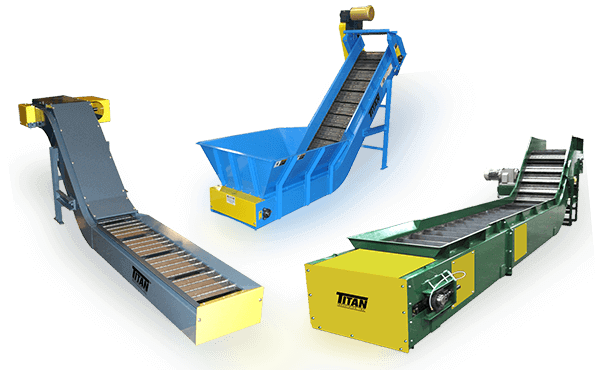
Hinged Steel Belt Conveyors

Conveyor belt systems are the most versatile of conveyors, it can be used to handle nearly every kind of part and all types of scrap, and used for chip removal & processing, forging, and stamping. Other common names for these conveyors are Piano Hinge Conveyors, Hinged Belt Conveyors and Hinged Slat Conveyors. Most applications involve handling metal, with the material often dropping with an impact that other conveyors could not withstand. Two-and-one-half pitch models handle most applications. Often, four- and six-inch pitch steel belt conveyors are needed for larger scrap, castings, forgings and any applications with heavy loads or long runs.

Our hinged steel belt conveyors are capable of combining single conveyor runs of horizontal and elevated movements. Our exclusive Radial Sidewings eliminate the gap between sidewings to provide a jam-free operation and a more efficient running conveyor. Only Titan offers Radial Sidewings on all pitch sizes.

Request a Quote
hinged steel belt conveyors

What is a hinged steel belt conveyor, and how does it work?

A hinged steel belt conveyor is a heavy-duty material-handling system that uses connected steel plates or hinged sections to create a continuous moving surface. The belt travels along a conveyor frame, carrying materials from one location to another as part of an industrial process. These systems are commonly used when businesses need to move metal parts, scrap, chips, or other materials that may be too abrasive, hot, or heavy for certain conventional conveyor belts. At Titan Conveyors, we help customers explore equipment options based on their applications and operating conditions. Businesses comparing conveyor belt and system manufacturers in MI can contact us to discuss their requirements and learn how a hinged steel belt conveyor may support their facility.

What types of materials can a hinged steel belt conveyor transport?

Hinged steel belt conveyors are designed for demanding applications involving materials that require a durable transportation surface. Depending on the conveyor’s construction and specifications, these systems may handle metal stampings, machining chips, scrap metal, castings, and other industrial materials. They can be especially useful when products have sharp edges or abrasive characteristics that could cause excessive wear on less durable conveyor surfaces. The right configuration depends on the size, weight, temperature, and volume of the materials being moved. When evaluating conveyor belt and system manufacturers in MI, it is important to consider how your materials may affect equipment performance. At Titan Conveyors, we can discuss your application and help you explore a conveyor solution suited to your material-handling needs.

Which industries commonly use hinged steel belt conveyors?

Hinged steel belt conveyors are frequently used in manufacturing and industrial environments where materials must be transported under demanding conditions. Metalworking facilities may use them to move machining chips, scrap, and metal components, while automotive manufacturers can incorporate them into production processes involving metal parts and assemblies. Foundries, stamping operations, and other facilities may also benefit from equipment designed to handle abrasive or heavy materials. Each application has different requirements, so conveyor selection should account for the facility’s production process and the characteristics of the materials being transported. Companies researching conveyor belt and system manufacturers in MI can discuss their industry and workflow with Titan Conveyors. We can help identify equipment considerations that may be important for their operations.

Can hinged steel belt conveyors handle hot or abrasive materials?

Hinged steel belt conveyors are often selected for applications involving materials that can be difficult to transport with conventional belt systems. Their steel construction makes them suitable for certain abrasive materials and industrial environments where durability is important. Depending on the design and operating specifications, they may also be used to move materials that retain heat after manufacturing or processing. However, temperature limits, material characteristics, load capacity, and operating conditions must be evaluated before choosing a system. At Titan Conveyors, we encourage customers to provide details about the materials they handle so we can discuss appropriate equipment options. If you are considering conveyor belt and system manufacturers in MI, we can help you evaluate the requirements of your application before selecting a hinged steel belt conveyor.

Can you customize a hinged steel belt conveyor for my facility?

A hinged steel belt conveyor can be configured to accommodate the layout and material-handling demands of a particular operation. Factors such as conveyor length, width, incline, discharge location, load capacity, and the type of material being transported can influence the system’s design. Some facilities need a conveyor that connects directly to manufacturing machinery, while others require equipment that moves scrap or other materials to a collection area.

Available Hinged Steel Belt Conveyors and Systems

Conveyors Pitch Belt Speed Sprockets Frame
Model 610 – 2 1/2″ Pitch Hinged Steel Belt Conveyor 2 1/2″ Per application
5-30 F.P.M. Typical
5 Tooth, 4.25″ P.D. Formed 12 Gauge
Model 620 – 2 1/2″ Pitch Hinged Steel Belt Conveyor 2 1/2″ Per application
5-50 F.P.M. Typical
5 Tooth, 4.25″ P.D. Formed 10 Gauge
Model 630 – 2 1/2″ Pitch Hinged Steel Belt Conveyor 2 1/2″ Per application
5-50 F.P.M. Typical
6 Tooth, 5″ P.D. Formed 10 Gauge
Model 640 – 4″ Pitch Hinged Steel Belt Conveyor 4″ 5-50 F.P.M. Typical 6 Tooth, 8″ P.D. Formed 10 Gauge
Model 660 – 6″ Pitch Hinged Steel Belt Conveyor 6″ 5-50 F.P.M. Typical 6 Tooth, 12″ P.D. or
8 Tooth, 15.68″ P.D.
Formed 7 Gauge
Model 350 – Pro Feed Steel Belt Parts Feeder 2 1/2″ Per application 5 Tooth, 4.25″ P.D. Square Tubing
Quench Conveyor 2 1/2″, 4″ or 6″ Per application Sized to Suit Formed 10 Gauge